The Purpose of Security Lighting
While ambient landscape lighting focuses on beauty and mood, security lighting is designed strictly for safety and deterrence. A dark property can provide cover for intruders, while sudden, bright illumination acts as a powerful psychological deterrent. Beyond security against break-ins, these lights also serve an essential safety function, ensuring you and your guests can navigate driveways, side alleys, and steep steps safely after dark.
The modern era of security lighting is dominated by ultra-bright, energy-efficient LED floodlights equipped with advanced motion sensors, displacing the power-hungry halogen bulbs of the past.
Motion Sensors: PIR vs. Microwave
The effectiveness of a security light relies heavily on its sensor technology. The two most common types found in residential outdoor lighting are PIR and Microwave sensors.
- PIR (Passive Infrared) Sensors: This is the most common technology. PIR sensors detect changes in infrared radiation (heat) moving across their field of view. When a warm body, such as a human or large animal, moves into the zone, the light triggers. They are highly reliable but can sometimes be triggered by swaying trees holding trapped daytime heat or sudden temperature changes.
- Microwave Sensors: These sensors emit microwave pulses and measure the reflection off moving objects, similar to radar. They are extremely sensitive and can even detect motion through glass or thin walls. Because of this high sensitivity, they are sometimes prone to false alarms from blowing debris or heavy rain, making them better suited to specific enclosed spaces.
Understanding Lux Levels and Glare
When selecting a floodlight, brightness is measured in lumens. A standard residential driveway can typically be well-lit by a fixture emitting between 1,500 to 3,000 lumens. However, brighter is not always better. Excessively bright lights can cause severe glare, temporarily blinding the homeowner or irritating neighbors. This phenomenon, known as light pollution or light trespass, is a common issue in dense residential areas.
To mitigate glare while maintaining security, focus on directional positioning. Point the fixtures sharply downward so the light pools exactly where it is needed on the ground, rather than projecting horizontally into the street or adjacent windows. Many high-quality fixtures feature adjustable cowls or visors to cut off excess light spill.
Strategic Placement Zones
Effective security lighting requires strategic placement rather than simply blanketing the entire property in light.
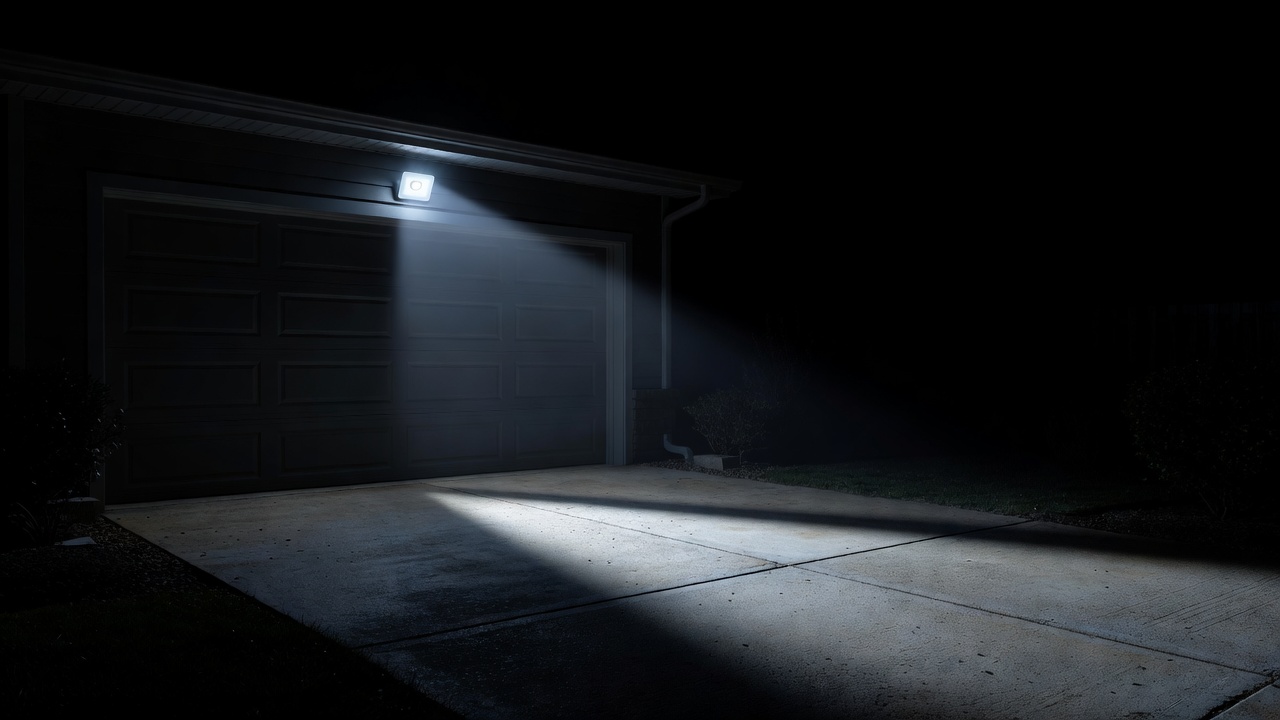
- Driveways and Garages: Mount lights high up under the eaves to provide a wide pool of light over the parking area, ensuring safe transition from car to house.
- Side Alleys and Gates: These are common blind spots. A motion-activated light positioned to trigger as soon as someone enters the alley provides excellent deterrence.
- Entry Doors: Combining a motion floodlight with a smart doorbell camera ensures clear, well-lit video footage of anyone approaching the main entrances.
Conclusion
Security lighting is a fundamental component of home safety. By choosing the right sensor technology, managing lumen output to avoid blinding glare, and strategically placing fixtures to cover vulnerable zones, you can create a secure perimeter that provides profound peace of mind.